Description:
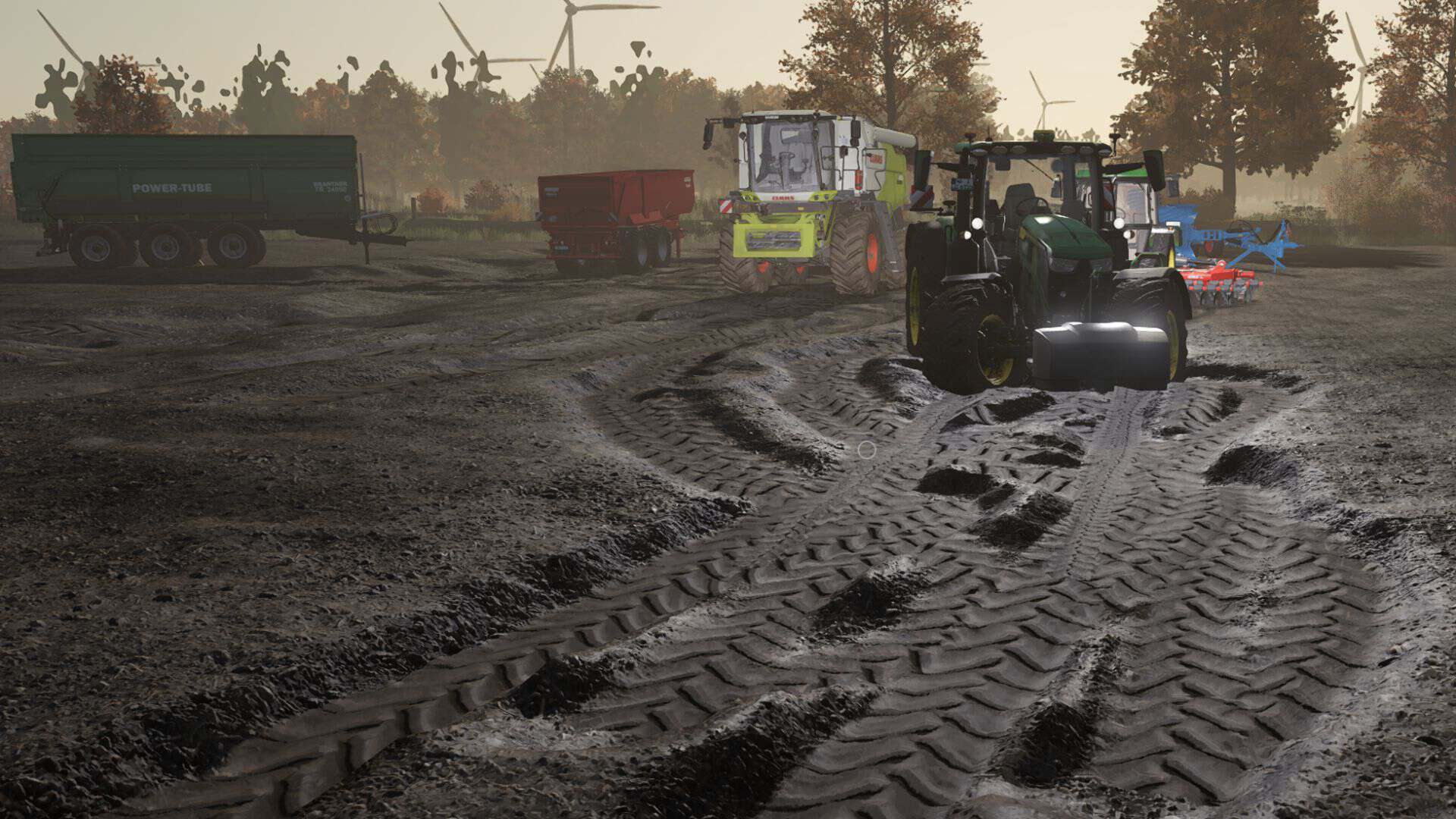
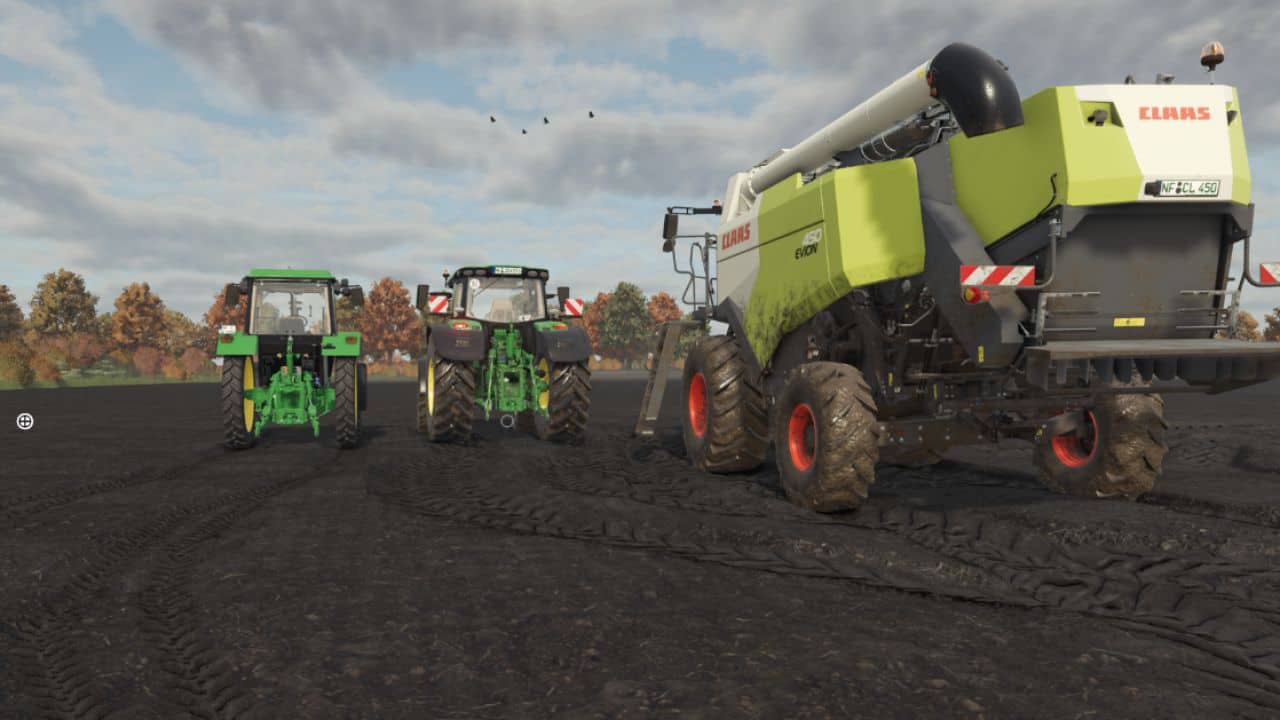
Visual Mud Tracks expands Farming Simulator 25 with a comprehensive simulation of lanes, soil moisture, tire behavior, compaction, fruit destruction, root damage and bogging. This means that vehicles react much more realistically to dry, moist and water-saturated soils.
The mod is designed for single player and multiplayer and can work with the **Realistic Water & Soil Management System**. Soil moisture, load capacity and waterlogging not only influence the display, but also tire contamination, sinking, slippage, driving resistance and plant damage.
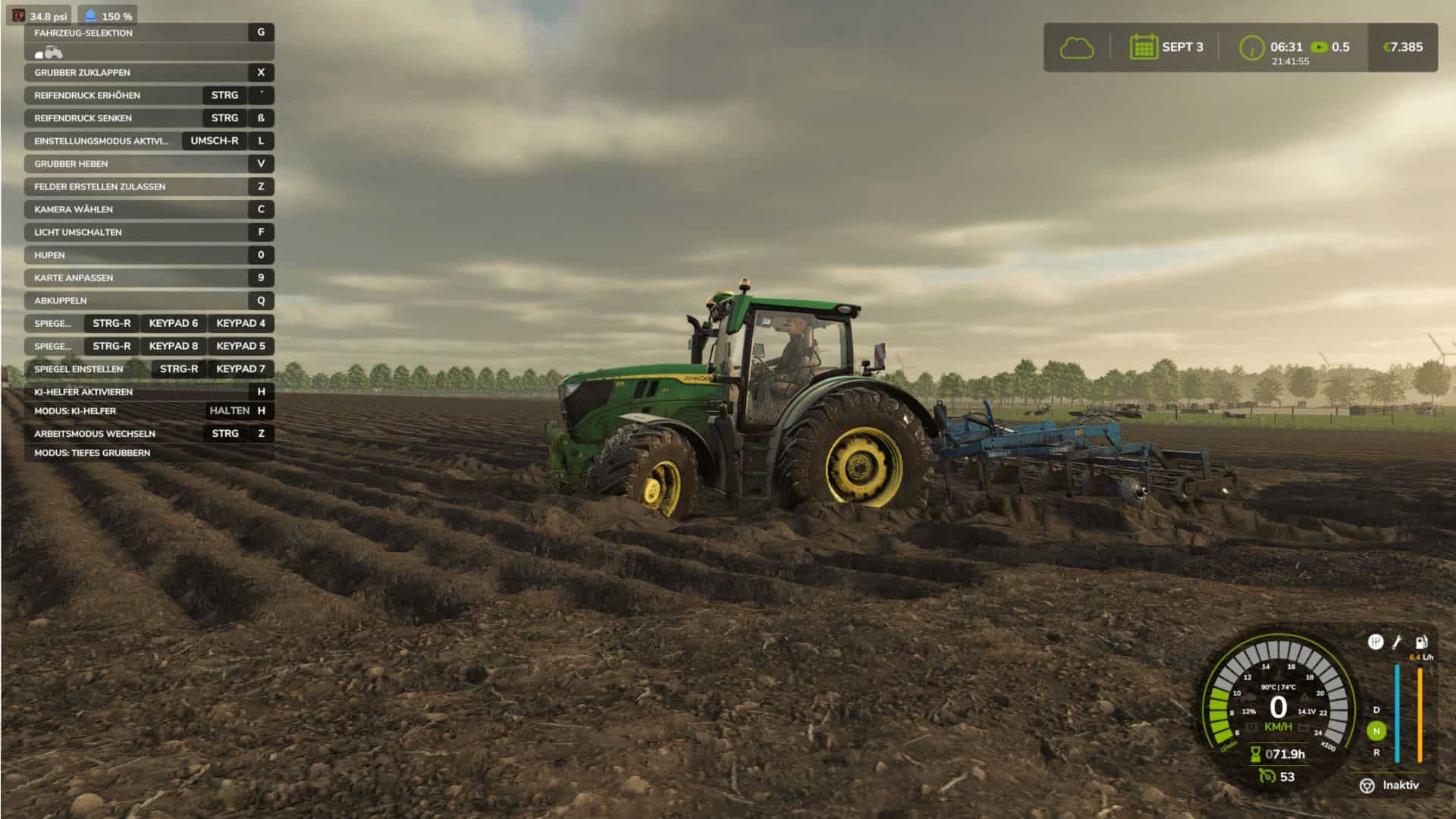
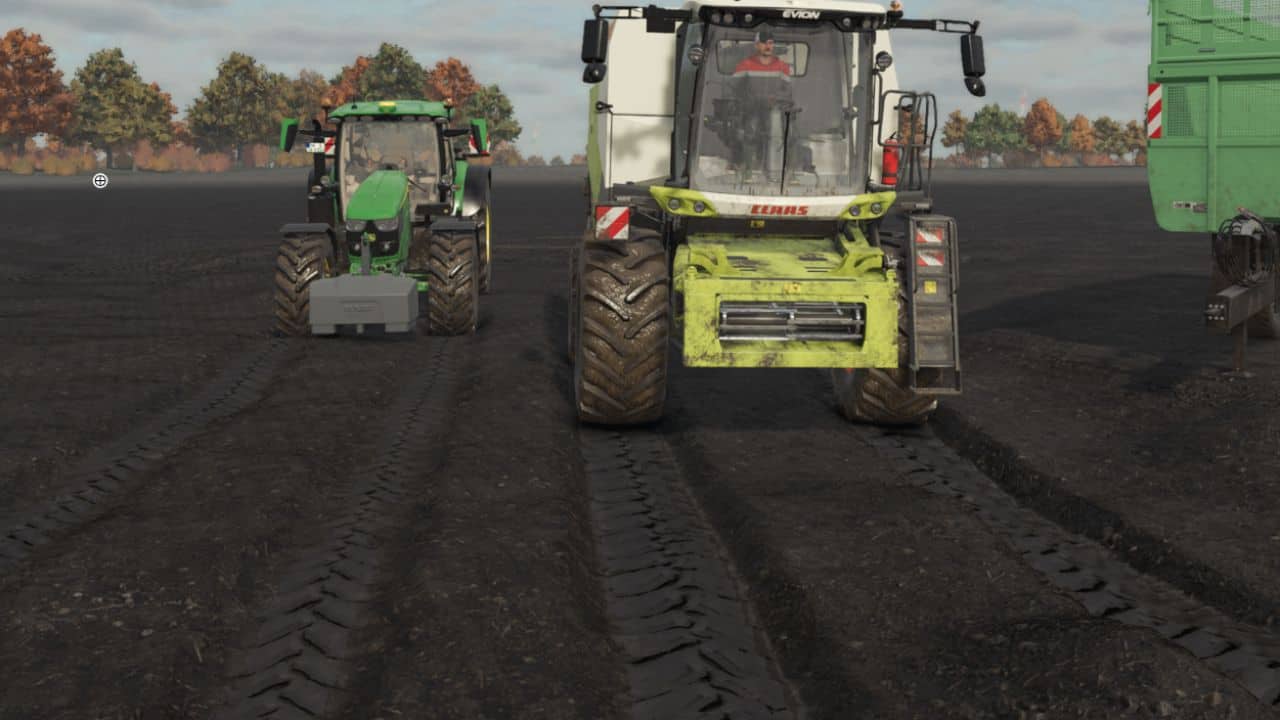
Physical lanes and terrain grooves
Tires can permanently lower the terrain and create real grooves in the terrain heightmap. The depth and width of the tracks are calculated individually for each wheel.
To be taken into account:
– Vehicle weight
– actual wheel load
– Tire width and tire radius
– Tire pressure
– Soil moisture
– Soil saturation
– Carrying capacity
– Speed
– Wheel slip
– Cornering
– Number of previous crossings
– Trailers, levels and attachments
Left and right bike lanes remain separate. The center of the vehicle is not lowered unnecessarily. The grooves have a narrow, steep cross section so that the edge areas do not sink over a large area.
Existing tracks can be deepened by further difficult crossings. A maximum depth protects the terrain from extreme deformation.
The groove is created directly at the actual wheel contact. There is no delayed post-processing behind the vehicle. Steered, mirror mounted and differently aligned wheels are taken into account.
Restoration through tillage
Physical lanes can be removed again through appropriate tillage.
The following are supported, among others:
– Plows
– Cultivator
– Disc harrows
– Subsoiler
– Mulcher
– Reels
– Seeders
– Direct seeding machines
– Planters
The terrain is only reset within the actual work area being worked on. Pending trace calculations and saved visual traces are also removed there.
Safe Terrain Journal
– The mod uses separate savegame files:
– `visualMudTracksTerrainBackup.xml`
– `visualMudTracksActiveRuts.xml`
– `visualMudTracksState.xml`
The original terrain height of a cell is saved during the first intervention and is not later overwritten by further passes. Active grooves and recovery information are managed separately.
This allows tracks to be reset in a more controlled manner. Interrupted restores can be resumed the next time you start the game.
Important note for updates: Before switching from an older version, existing lanes with the old version still installed should be removed using tillage equipment and the score saved. Grooves that have already been permanently written into the terrain height map may otherwise remain.
Visible and physical sinking
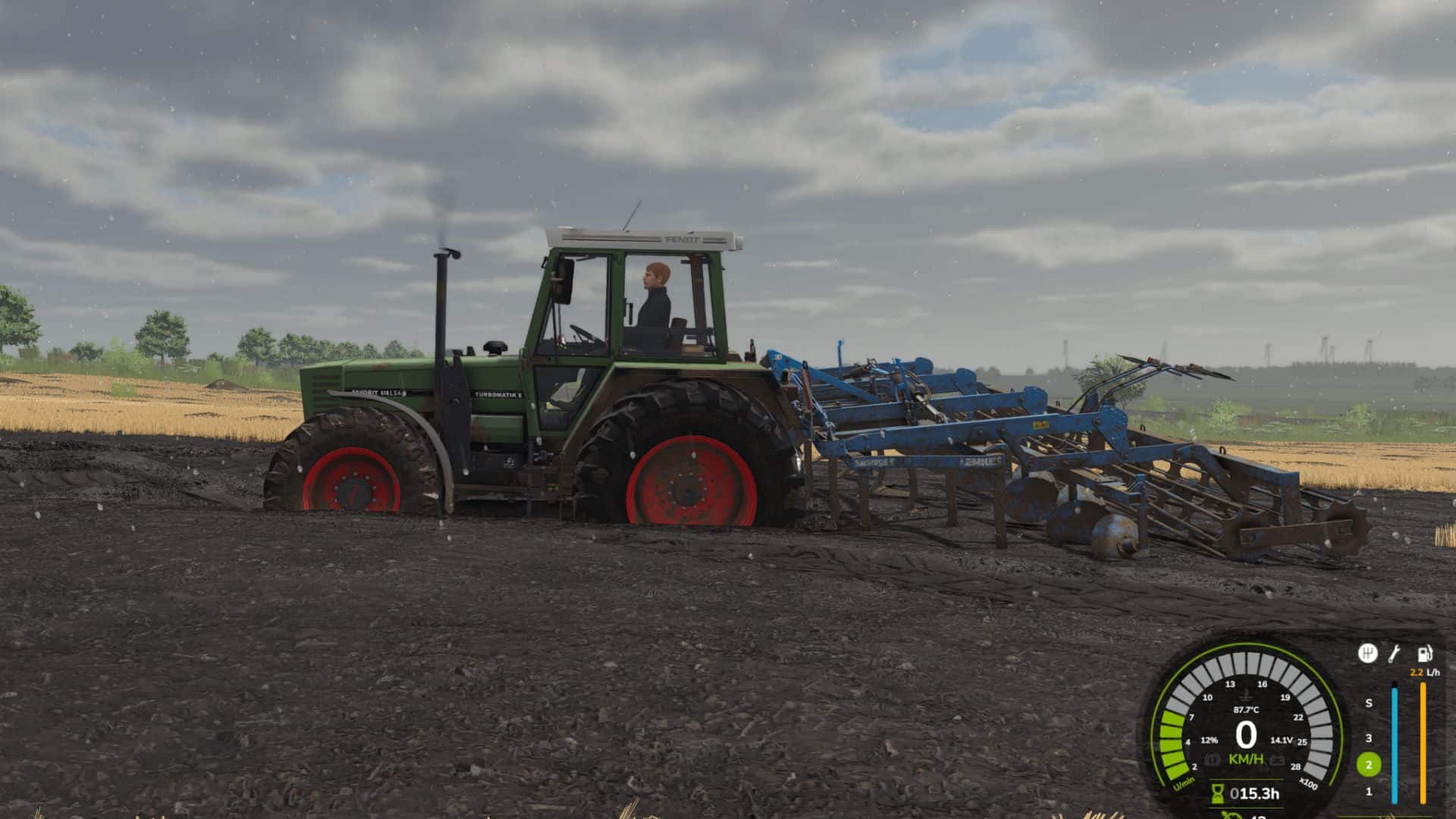
Tires visibly and physically sink on soft and wet surfaces. The sinking is implemented via the effective wheel physics radius. This means that the tires, suspension and ground contact react together.
The sinking occurs progressively and not suddenly. On solid ground, the wheel lifts itself out of the ground in a controlled manner.
The sinking depth depends on:
– Soil moisture
– Saturation
– Carrying capacity
– Wheel load
– Tire width
– Tire pressure
– Speed
– Slip
– existing track depth
Wide tires distribute the load better. Narrow, heavily loaded tires cut deeper.
Tire pressure system
The tire pressure can be changed while driving. The value is saved for each wheel and synchronized in multiplayer.
Low tire pressure:
– increases the contact area
– Improves grip on soft ground
– reduces cutting
– can make it easier to get out of soft tracks
High tire pressure:
– reduces the contact area
– increases cutting
– increases the risk of getting stuck on wet ground
– may be cheaper on solid ground
A compact HUD shows the current pressure in bar and evaluates it in color.
Soil moisture HUD and RWSM connection
The Soil Moisture HUD shows the current RWSM topsoil value in percent. The display uses the same soil moisture value as the RWSM field info.
Values above 100 percent can represent severe waterlogging or waterlogging.
RWSM soil moisture affects:
– Sludge content
– Tire contamination
– Particle effects
– Carrying capacity
– Sinking depth
– Tire grip
– Wheel slip
– Groove depth
– Danger of getting stuck
– Fruit and root damage
Increased soil moisture caused by irrigation can also change the soil physics.
Tire dirt and mudThe amount of mud is stored individually for each tire. A tire remains dirty after leaving the field and cleans itself depending on the surface.
– Asphalt cleans quickly
– Gravel cleans slower
– Clean dirt roads only slightly
– high speed throws more mud out of the tread
– Rain also washes off the tires
– a light film of dirt may remain
The particle effects distinguish between dry earth and wet mud.
Included are:
– fine dry soil particles
– medium dry soil particles
– fine wet splashes
– medium mud particles
– rare heavy mud lumps
The amount of particles depends on wheel rotation, slip, tire width, radius, moisture, sink factor and load capacity. Particles are only generated when there is suitable ground contact.
Progressive stuck physics
On heavily waterlogged and less stable ground, a vehicle can progressively become stuck.
Continuous slippage causes driven wheels to dig in further. At the same time, the transferable grip decreases and the driving resistance increases.
To be taken into account:
– Soil moisture and saturation
– Carrying capacity
– Wheel load
– Tire pressure
– Slip
– Speed
– Engine utilization
– Engine speed
– Tensile load
– Working resistance
– Duration of exposure
Plows, cultivators, disc harrows, subsoilers, seed drills, power harrows and rollers produce different pulling resistances. Working width and working depth influence the power requirement.
In extreme conditions, propulsion can be almost completely lost.
Lifting or uncoupling an implement immediately reduces the additional load. Controlled reversing can reduce the digging condition and free the vehicle along its own lane.
Soil compaction
– Vehicles compact the top and bottom soil depending on wheel load, soil moisture, slip and number of passes.
Included are:
– Topsoil compaction
– Subsoil compaction
– Stronger compaction in wet soil
– Multiple experiences
– Additional load due to cornering and slipping
– Plow sole for frequent plowing
– Different effects of plow, cultivator and subsoiler
– Targeted reconsolidation by rolling
– slow biological recovery
Compaction and soil structure can be viewed in the field info.
Fruit destruction
Plants in the immediate tire area may be damaged or completely removed. The native LS25 fruit destruction is used for this.
The damage depends on:
– Wheel load
– Tire width
– Soil moisture
– Slip
– Cornering
– Growth stage
– Root health
– Soil structure
– Number of crossings
Young plants react more sensitively. Repeated crossings significantly increase the damage.
Normal tires remove plants after several trips over the same spot at the latest. Detected maintenance tires reduce the damage, but do not prevent it completely if the vehicle is driven frequently.
Root Health
Each contaminated soil cell can receive its own root health value.
Root damage occurs due to:
– high wheel load
– wet ground
– strong slip
– Cornering
– Multiple crossings
– unfavorable growth stages
– compacted soil
If root health declines, the risk of visible plant damage increases.
– below 70 percent: increased sensitivity
– below 40 percent: further crossings lead to destruction more quickly
– less than 20 percent: very high risk of failure
Root health is saved and can slowly recover biologically.
Field info and settings menu
The mod expands the field information to include numerous land values, including:
– Soil compaction
– Underbody status
– Root health
– Soil structure
– Sink factor
– Carrying capacity
– Fruit and root damage
The settings menu contains detailed descriptions of all options. High and low values, interactions, performance consequences and save game effects are explained.
The menu texts are available in twelve languages:
– German, English, French, Spanish, Italian, Dutch, Polish, Portuguese, Russian, Czech, Hungarian and Turkish.
Multiplayer and performance
The crucial physics calculations run on the server side. Tire pressure, contamination and important soil conditions are synchronized.
To optimize performance, the mod uses:
– limited groove points
– adjustable storage intervals
– Event and bulk caches
– sleeping floor cells
– Reduced refresh rates for removed or inactive areas
– delayed safe initialization of the particle systems
– Clean release of particle effects when deleting vehicles
Tire contamination / GIANTS-Washable
– Tire contamination fully adapted to the original GIANTS washable system.
– VMT leaves the original LS25 tire dirt as a basis and no longer writes its own dirt/wetness values on dry fields or grass.
– Additional VMT mud is only activated when the ground is actually wet or soft.
– Mud color tuned darker; Build-up and breakdown occur more slowly and naturally.
– When exiting real mud conditions, the original GIANTS dirt/wetness/color condition will be restored and will not be overwritten further thereafter.
– VMT-Radschlamm remains savegame and multiplayer capable.
Driving physics / sinking / suspension
– Stuck driven wheels can create a physical terrain groove directly at the wheel contact even without forward movement.
– If there is a lot of slip when stationary, a short, elongated tire pocket is created in the direction of rolling instead of just a transverse line.
– Temporary wheel radius sinking and permanent heightmap groove are offset against each other so that the same effect is not shown twice.
– Transitions to real terrain deformation remain continuous so that vehicles do not jump up or sink additionally when a groove occurs.
– Wet/soft floors affect wheel suspension via the native GIANTS interface setSuspensionMultipliers.
– The original vehicle/axle suspension remains the technical basis; VMT does not replace XML spring values.
– On heavily saturated ground, the suspension is softer, but the damping is deliberately kept higher. Low tire pressure increases compliance slightly.
– Dry fields, roads and frozen ground continue to use the original GIANTS suspension.
– Existing RWSM/VMT soil data will be reused; no additional full field or DensityMap queries for the suspension.
Permanent terrain grooves
– Permanent heightmap grooves are written directly on the actual wheel contact.
– The previous delayed groove queue has been removed because batched subsequent terrain writes could cause larger sections of terrain to sink behind the vehicle.
– Distance-based sampling is retained; there are still no heightmap writes in each frame.
– Wheel contact may only leave grooves at the same depth or lower them further, never raise them.
– Existing grooves no longer jump up when you drive over them again.
– Before each write, the actual terrain height is taken into account; the effective groove depth is monotonic.
– Tillage remains the normal path, which is allowed to consciously raise a saved groove again.
Unchangeable original height
– For each persistent groove, the original height is permanently locked when first detected.
– originalHeight may not be replaced by later wheel contacts, loading, verification or migration.
– When loading, the current heightmap depth is only observed and not adopted as the new logical groove depth.
– This prevents saved grooves from being gradually committed deeper and deeper upon reboot or mod update.
– VMT only stores the logical depth actually applied by VMT.
– In legacy migrations, if several old entries meet the same new cell, the original height that was adopted first is retained.
– Cultivator/plow always returns to this unchangeable original height.
Savegame persistence/update security
– Groove persistence extended to Format 7 / Restore Scheme 3.
– Older save game formats 3, 4, 5 and 6 remain readable and are migrated in an update-safe manner.
– Exact world position X/Z of each groove is stored in addition to grid indices.
– The original height, applied depth and absolute target height are saved.
– Old grooves are found again via their physical world position and not just via possibly differently quantized heightmap keys.
– Primary and backup files use a monotonic save sequence; When loading, the newer valid generation wins.
– Persistence files are reopened after writing and validated for format, restore scheme, sequence and groove count.
– The dirty state is only reset after successful validation.
– Temporary terrain write errors no longer discard loaded grooves; they remain until they are successfully processed.
– The final save game callback is registered centrally via the VMTSaveCoordinator.
Loaded grooves / double deformation
– When loading, VMT first checks the heightmap already saved by GIANTS.
– If the physical groove already exists, it will not be written into the terrain again.
– This means that grooves are not applied deeper again after a restart or mod update.
– If a groove actually needs to be added, this is done exclusively via the Lower-Only-Terrain-Writer.
– A mod update cannot raise existing terrain.Tillage/Restoration
– Cultivators and plows reset persistent grooves to the saved original height.
– A groove entry is not deleted until the recovery is written successfully or the original height is already physically present.
– In the event of temporary terrain write errors, the groove remains saved and can be reprocessed later.
– After successful tillage, the groove will be removed from the persistent chunk record and will not appear again after restart.
– Old or newly quantized groove cells at work area edges are reliably detected.
– Terrain that is already higher than the original historical height due to landscaping or map updates will never be lowered to the old value again.
Performance in old save games
– A 16 m spatial index has been added for persistent grooves.
– Cultivators and plows only check grooves in the immediate vicinity of their current work area.
– Expensive wide heightmap/grid passes over large areas have been removed.
– Legacy baselines are only reconstructed when necessary for the actual cell being edited; no full card scan.
– Lazy load verification of old grooves heavily budgeted so that saves with many thousands of grooves do not produce large FPS spikes.
– Chunk-based storage and local queries remain the foundation for large savegames.
Stability / Entity Security
– Added protection against GIANTS entities that have already been deleted.
– Vehicle nodes are checked with entityExists before world position, speed and direction queries.
– Invalid vehicles no longer enter the VMT physics cache; Wheel position queries only fall back to valid nodes.
– Stuck, mud, groove, tire pressure and traction logic remains stable even when deleting or selling vehicles.
User Interface/Localization
– Fixed VMT menu header L10N error; “Visual Mud Tracks” appears without a missing translation key.
– HUD, tire pressure, soil moisture and multiplayer displays are retained.
Compatibility
– RWSM connection for moisture, saturation, load capacity and compaction is retained.
– Tire pressure, slip, sink physics, wet suspension, mud particles, compaction, multiplayer and savegame persistence continue to work together.
– GIANTS-native tire contamination and vehicle physics remain the basis; VMT only supplements the wet/soft ground effects.
– Existing saves with grooves from older VMT versions remain loadable and can be migrated without restarting the career.
Current status: Visual Mud Tracks 1.37.1.15
Required:
– Realistic Water & Soil Management (RWSM)