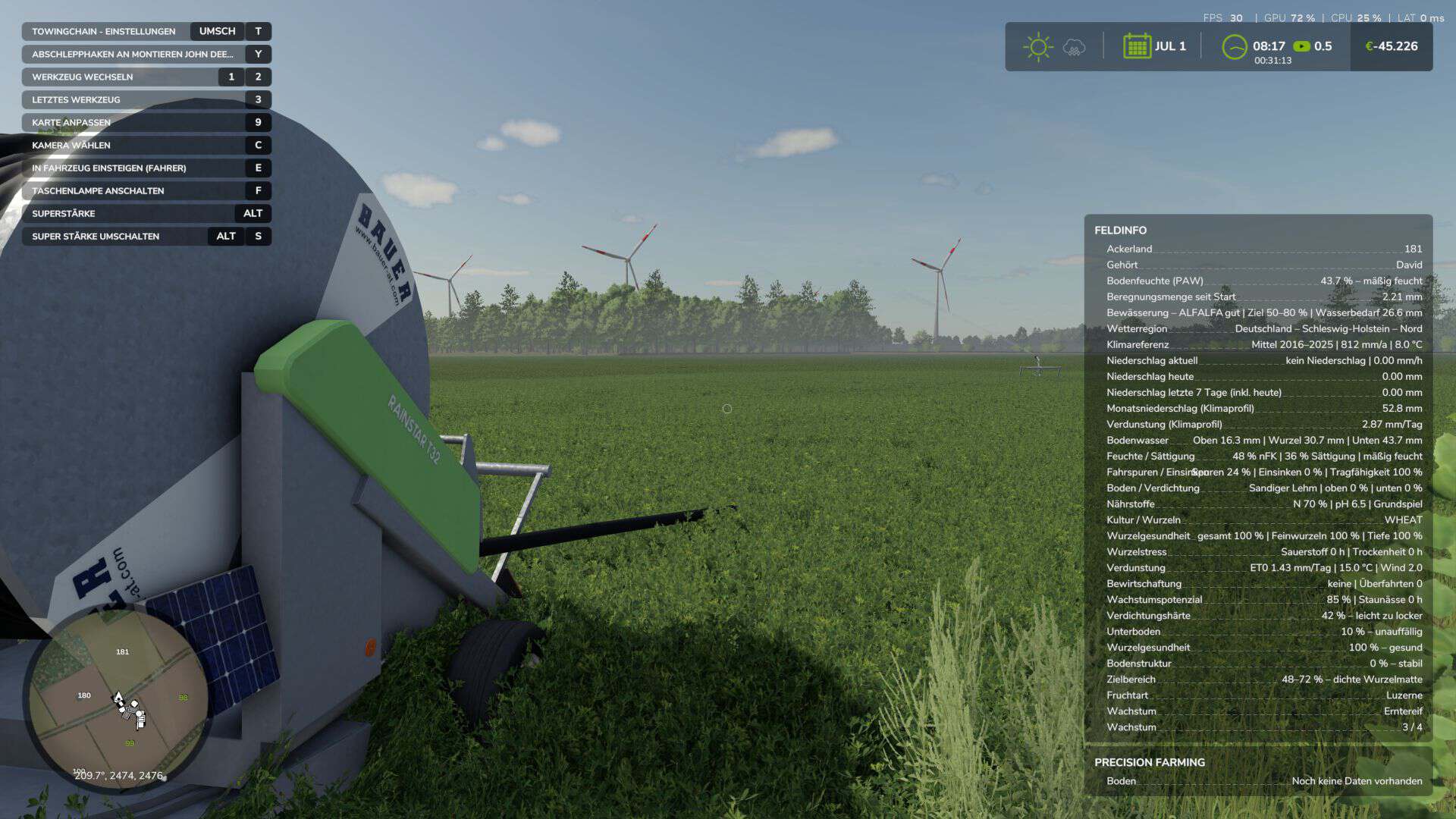
Realistic Water & Soil Management expands Farming Simulator 25 with a permanently stored water, soil and plant balance.
Rain, irrigation, evaporation, soil type, terrain, compaction, tire pressure, tillage and plant development are directly intertwined. As a result, fields no longer only react with simple conditions such as “dry” or “wet”, but rather have a multi-layered water balance with topsoil, root zone and subsoil.
Natural depressions stay moist longer, heavy vehicles compact wet soil more and inadequate tire pressure increases the load on the topsoil. These influences have long-term effects on soil structure, root health, plant development and yield.
Features
Multi-layered water balance
The soil water balance is calculated separately for:
– Topsoil from 0 to 10 cm
– Root zone from 10 to 30 cm
– Subfloor from 30 to 60 cm
Precipitation, irrigation, evaporation, seepage, drainage, surface runoff, plant water absorption, soil type, soil structure, compaction and landform are taken into account.
The usable field capacity is displayed separately from the complete pore saturation. Water above field capacity appears as excess water and can seep away, run off or cause waterlogging.
Different soil types
– RWSM differentiates between different types of soil with their own properties, including:
– loamy sand
– sandy loam
– Clay
– silty clay
Each soil type has its own values for field capacity, wilting point, water retention, infiltration, drainage, bearing capacity, risk of compaction and sinking depth. Sandy soils dry faster. Loamy and clay-rich soils store more water, but remain soft longer and are at risk of compaction.
Dynamic weather and climate
– Regional climate profiles influence:
– Precipitation
– Temperature
– Evaporation
– Wind
– Humidity
– Sunlight exposure
– seasonal distribution
The game’s actual weather data directly affects soil moisture, drying and evaporation.
Realistic drying
Drying does not take place via a simple timer. Temperature, wind, sun, humidity, soil type, compaction and surface water determine the speed.
A wetness memory prevents a field from becoming completely dry and viable again immediately after rain.
Natural depressions and waterlogging
– RWSM detects local low areas within a field.
These areas:
– collect water
– dry more slowly
– have lower load capacity
– Promote sinking and track formation
– increase the risk of compaction
– can cause oxygen deficiency to the roots
The terrain evaluation is cached for better performance.
Soil compaction
– The compression is saved separately for:
– Topsoil
– Root space
– Underbody
have an influence:
– Vehicle weight
– Payload
– Wheel load
– Axle load
– Tire width
– Tire pressure
– recommended field pressure
– Soil moisture
– Soil type
– Slip
– Speed
– Cornering
– Multiple crossings
High tire pressure puts greater strain on the topsoil for the same wheel load. A suitable low field pressure increases the contact area and protects the ground. High axle loads can still compact deeper soil layers.
Multiple crossings
– Repeated crossings of the same lane are taken into account.
– The first crossing usually causes the greatest immediate damage. Further passes further compact the already contaminated soil.
Among other things, the following are saved:
– Crossings
– Compaction
– Track depth
– Shear damage
– Plant damage
– Edit history
Roots and plant stress
– RWSM simulates:
– Root health
– Fine root health
– achievable root depth
– Drought stress
– Waterlogging
– Lack of oxygen
– Compaction stress
– Nutrient stress
– pH stress
– mechanical damage
Damaged roots are less able to absorb water and nutrients.
Impact on earnings
– The actual yield is influenced, among other things, by:
– Water balance
– Dryness
– Waterlogging
– Root health
– Compaction
– Soil structure
– Nutrients
– pH value
– Seedbed
– Weeds
– Lanes
– mechanical damage
Damage does not take full effect immediately, but builds up depending on the strength and duration.
Crop Vitality Visuals (Alpha Version)
– A stored vitality system creates local differences in the plant population.
Possible are:
– different plant heights
– changed stock density
– incomplete stocks
– Visible stress zones
– weaker development
– Storage locations
The plants remain technically ready for harvest. RWSM does not alter original growth or harvest maturity levels.
Weed competition
Weeds compete with cultivated plants for water, nutrients, light and development space. Strong weed pressure can reduce development and yield.## Tillage
Different devices have different effects:
– Plow
– Cultivator
– Disc harrow
– Rotary harrow
– Subsoiler
– Seeder
– Roller
Working depth, soil moisture, compaction, soil structure, seedbed strength, multiple cultivation and possible plow soles are evaluated. Deep loosening is only fully effective when the soil moisture is suitable. Cultivating when the soil is too wet can cause additional structural and lubrication damage.
Seedbed and rollers
– RWSM evaluates seedbed strength.
– A seedbed that is too loose offers poor soil sealing. Too much reconsolidation can impair air flow and root development.
– Rolling acts as a real area-wide reconsolidation and is evaluated depending on the type of soil, moisture and compaction.
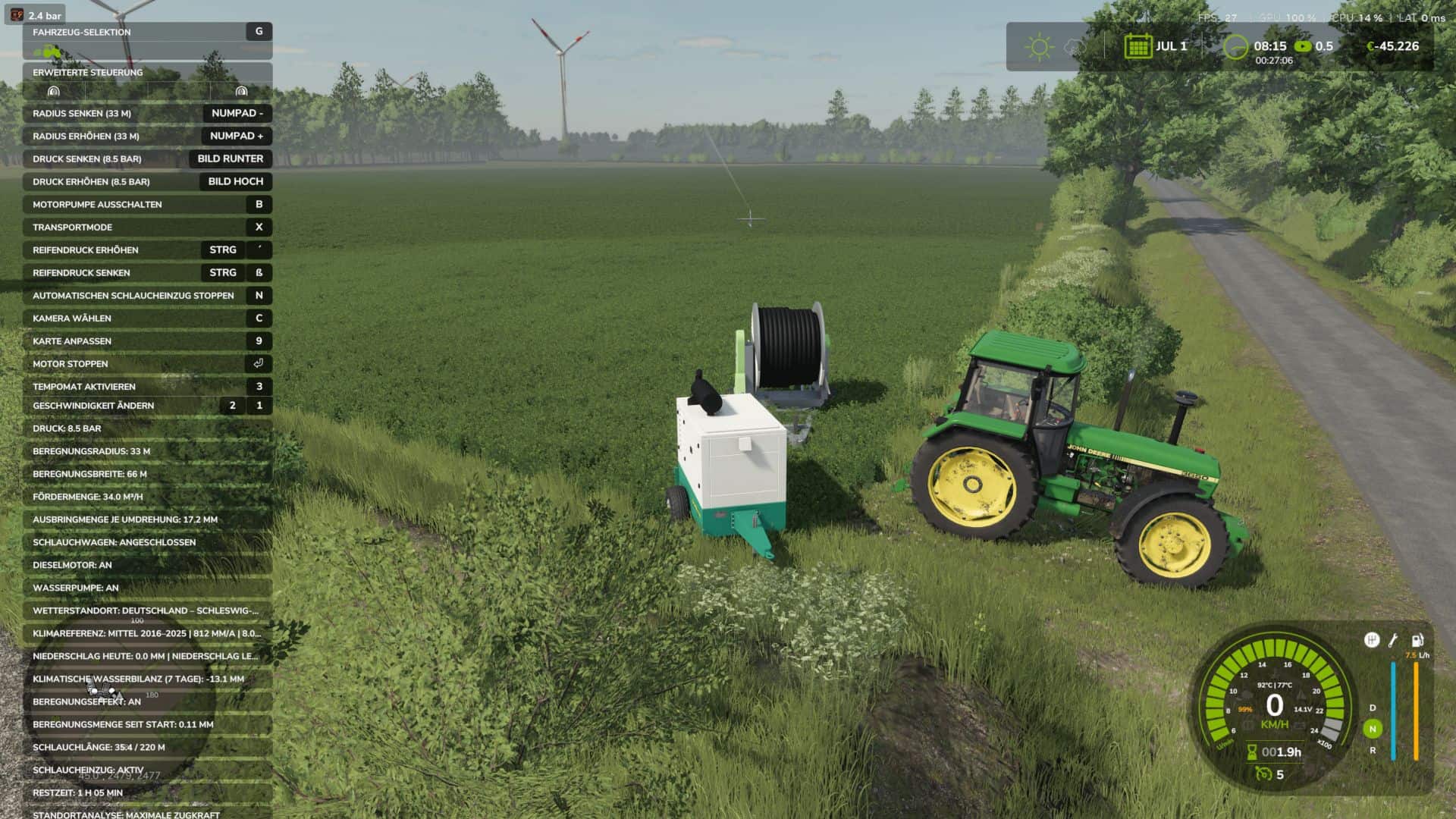
Irrigation system
The mod includes a functional Rainstar irrigation system with:
– Motor pump
– Hose reel
– Sprinkling rail
– adjustable pump pressure
– adjustable radius
– real application rate
– Water consumption
– Soil input in millimeters
– automatic hose retraction
– Work and transport mode
– Parking brake
– Clutch aid
– Connection markers
– sound
– visible water jet
The water applied changes the actual water balance of the soil.
Extended field info
– The field info shows, among other things:
– Topsoil moisture
– Pore saturation
– Surface condition
– Excess water
– Water in all layers of soil
– Soil type
– Evaporation
– Temperature and wind
– Compaction
– Soil structure
– Seedbed strength
– Root condition
– Plant vitality
– visible height and density
– main cause of stress
– Climate values
Water-Soil API
RWSM provides a versioned interface for other mods.
The API provides, among other things:
– Soil type
– Soil moisture
– Pore saturation
– water available to plants
– Surface moisture
– Carrying capacity
– Trafficability
– Sink factor
– possible sinking depth
– Compaction
– Track depth
– Root condition
– Evaporation
– recommended tire pressure
– Plant vitality
Other mods can report traffic loads and ground effects back to RWSM.
Connection with Visual Mud Tracks
– In connection with Visual Mud Tracks, among other things, the following are transmitted:
– Wheel load
– Axle load
– Tire pressure
– Tire width
– Slip
– Vehicle weight
– Payload
– Soil moisture
– Carrying capacity
– Sink factor
– possible track depth
This allows visible tracks, sinking, mud and tire behavior to be linked to the actual ground condition.
Saving and multiplayer
– The following are permanently stored and synchronized, among other things:
– Water balance
– Precipitation history
– Compaction
– Track depth
– Soil structure
– Root condition
– Edit history
– Plant vitality
– Irrigation data
– Pump pressure
– Irrigation radius
– Hose retraction
The calculation is server authoritative and designed for multiplayer saves.
1.Multi-layered water balance
Topsoil, root zone and subsoil react separately to rain, irrigation, evaporation and infiltration.
2. Long-term compaction with an impact on yield
Tire pressure, wheel load, axle load, soil moisture, slip and multiple passes influence the soil and plants in the long term.
3. Direct connection to Visual Mud Tracks
Soil moisture and load capacity control sinking, tracks, mud and tire behavior.
4. Local waterlogging in natural depressions
Low areas stay wet for longer and become real problem areas.
5. Visible Plant Vitality
Elevation, density and stress zones can vary locally without changing crop maturity.
6. Realistic tire pressure influence
Excessive pressure increases topsoil stress, while appropriate field pressure protects the soil.
7. Root Health and Long-Term Plant Stress
Dryness, waterlogging, compaction, pH value and nutrients work together.
8. Functional irrigation
Pump pressure, radius and application rate determine the real water input.
9. Different tillage systems
Plows, cultivators, subsoilers and rollers have their own effects and risks.
10. Extensive field info
Water, soil, compaction, roots, seedbed and plant condition are directly visible.
11. Persistent Multiplayer System
Ground and water damage is retained and synced after saving.
12. Open Water-Soil API
Other mods can read land values and connect their own systems to them.
13. No change in growth stages
RWSM assesses and visualizes plant stress without overwriting original harvest maturity levels.
Required:
– Precision Farming
– Visual Mud Tracks